EU’s top leaders attend India’s Republic Day ahead of 16th EU–India Summit on 27 January
European Council President António Costa and European Commission President Ursula von der Leyen travelled to New Delhi to represent the EU at the 16th EU–India Summit scheduled for 27 January 2026. They also joined India’s 77th Republic Day celebrations as guests of honour, signalling stronger EU–India strategic engagement across trade, security, technology and the clean transition.
- Reporting desk
- Health India Network News Desk
- First published
A high-level EU delegation in New Delhi
The European Union’s top leadership arrived in India for a two-day sequence of high-visibility engagements: participation in India’s Republic Day parade on 26 January 2026, followed by the 16th EU–India Summit in New Delhi on 27 January 2026. The visit placed India–EU ties in the global spotlight, as both sides attempt to project a closer partnership amid shifting geopolitical and economic realities.
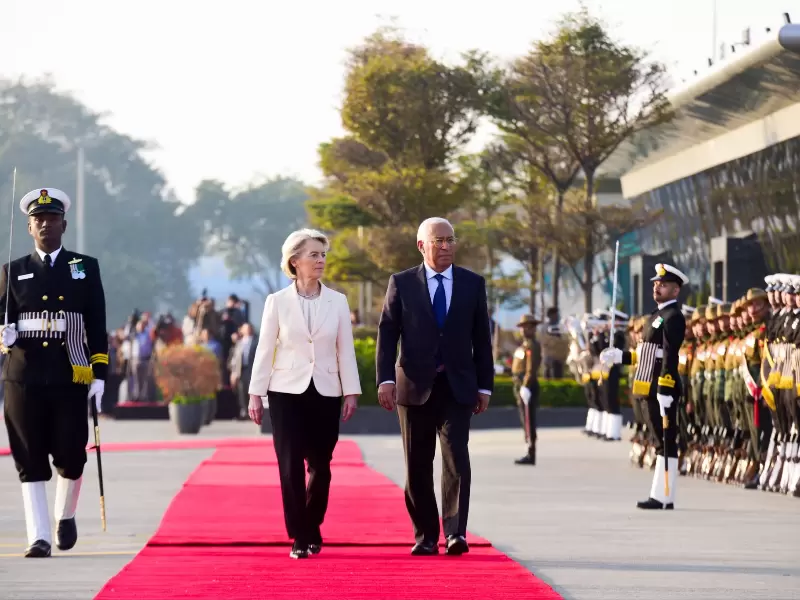
According to the European Council’s announcement, the summit is designed to build on the EU–India strategic partnership and to advance cooperation across multiple policy tracks. The EU said the agenda includes trade, security and defence, the clean transition, and people-to-people cooperation—areas where both sides increasingly see mutual benefit.
Republic Day participation as a diplomatic signal
The EU leaders’ presence at the Republic Day parade was framed as a sign of strengthening bilateral relations. Their attendance, alongside the summit, gave the visit both symbolic and practical weight: symbolism through association with India’s national day, and substance through the policy discussions scheduled with Indian leadership the next day.
The European Council also linked the trip to a wider framework of engagement, noting that an EU strategic agenda on India had been endorsed in October 2025. That context suggests the EU wants the relationship to move beyond episodic summits toward more structured cooperation—particularly in technology and innovation, connectivity and global issues, and security domains.
What the summit is expected to focus on
At the summit, the EU leaders are expected to meet Prime Minister Narendra Modi in New Delhi and discuss the future direction of the partnership. Key discussion areas, as outlined by the EU, include trade ties, security and defence collaboration, coordination on the clean transition, and expanding links between citizens and institutions.
In practical terms, the EU–India relationship is frequently tested by the need to align economic objectives with regulatory preferences and strategic constraints. Yet the scale of the delegation and the explicit list of agenda items indicate a push for deliverables that can be presented as progress—especially on the economic and security tracks, where both India and the EU face external pressures to diversify partners and reduce vulnerabilities.
Why this matters beyond India and Europe
The EU’s decision to send its top two leaders to India around Republic Day places the partnership in a broader international frame: it is not only about bilateral trade volumes but also about positioning in global supply chains, technology standards, energy transition financing and security cooperation. With multiple regions experiencing instability and trade routes under stress, both sides appear motivated to show that major democracies can deepen cooperation while preserving strategic autonomy.